

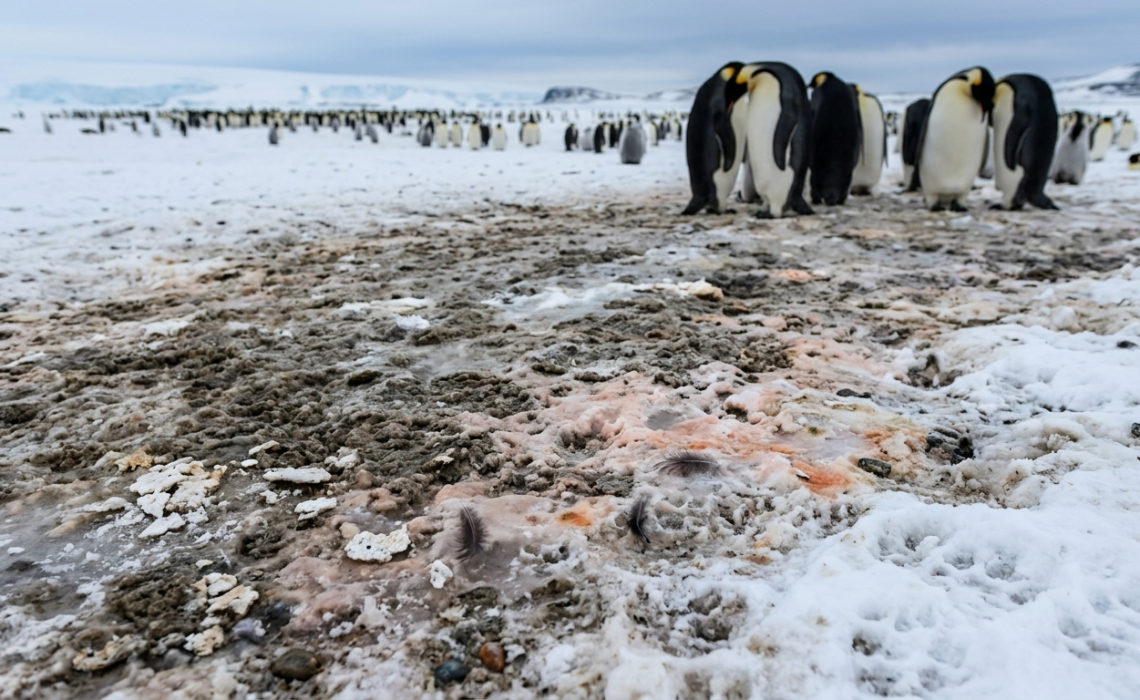
Penguins are brilliant indicators of the health of our planet. When you stand amongst the Snow Hill Emperor Penguin colony in Antarctica, it’s easy to realise that every single creature down there plays a vital role in keeping our fragile climate balanced.
Not so easy to visualise if you haven’t been! And with only about 1.7 million Antarctica visitors out of a global population of 8.3 billion, the odds are you haven’t had that chance. That is exactly why I see it as my role as an ‘ambassador’ for this extraordinary region to bring these vital stories directly to you.
By sharing these fascinating new nuggets of information, I hope to show how interconnected we all are. It’s a gentle reminder that each of us, no matter where we live, can make small, daily changes that collectively slow down climate change – and help protect these magnificent Emperor penguins and the precious sea ice they depend on for survival.
So, returning to the point of this article, recently, scientists have uncovered a mind-blowing, slightly smelly fact that takes the phrase “nature provides” to a whole new level. It turns out that penguin poop – yes, you read that right, guano! – is actively involved in a natural process akin to cloud seeding that helps cool the Antarctic atmosphere (Cartier, 2025).
The Chemistry of Cloud Seeding
We often think of clouds as pure, rolling masses of water vapour, but liquid water cannot condense out of thin air to create cloud droplets without a tiny particle to cling to – what scientists call an aerosol or a cloud condensation nucleus (Cartier, 2025).
In the pristine, isolated expanse of Antarctica, these cloud-forming particles are incredibly rare. Enter the penguins.
When hundreds of thousands of penguins gather, they produce massive amounts of pungent guano. This poop releases substantial amounts of gaseous ammonia into the air – sometimes 100 to 1,000 times higher than baseline levels (Cartier, 2025). When this ammonia wafts into the sky and mixes with sulfuric gases released by marine phytoplankton, magic happens. The particle formation speed shoots up by a staggering 1,000 times faster (Cartier, 2025).
If you add other gases emitted from the guano, like dimethylamine, into the mix, aerosol formation can skyrocket 10,000-fold (Cartier, 2025). Under the right wind conditions, these tiny particles float over the Southern Ocean, seeding thick, low-atmosphere clouds. Because these clouds are highly reflective, they act like giant mirrors, bouncing sunlight back into space and cooling the regional climate below (Cartier, 2025).
A System in Trouble: The Declining Populations
This extraordinary natural defense mechanism brings us face-to-face with a heartbreaking paradox. The very birds creating the coolant for the continent are under unprecedented existential threat.
Emperor penguins (Aptenodytes forsteri) are entirely dependent on stable “fast ice” – sea ice locked to the coastline – to survive, breed, and raise their chicks (Kidangoor, 2026). However, because of human-caused global warming, this ice is vanishing at an alarming rate. Groundbreaking satellite data revealed a terrifying new crisis: the penguins’ annual molt (Kidangoor, 2026).
Every summer, emperor penguins must undergo a “catastrophic molt,” meaning they shed all of their feathers at once to grow a new waterproof coat (Kidangoor, 2026). During this time, they cannot enter the freezing water to feed and are completely defenseless. As Rob Martin, Red List Team Manager at BirdLife International, explained in a recent interview, sheets of sea ice are breaking apart with such unprecedented frequency that the birds are left with vanishingly slim chances to escape to safer zones (Siskind, 2026).They require rock-solid, predictable sea ice platforms. Tragically, satellite imagery tracked a major molting refuge along West Antarctica’s Marie Byrd Land coast that has shrunk dramatically due to record-low ice years (“Satellites Reveal,” 2026). Between 2022 and 2024, the regional fast ice shattered entirely before the penguins finished molting, causing scientists to fear that immense numbers of adults perished in the ocean without waterproof protection (British Antarctic Survey, 2026).
Before 2022, over 100 groups of penguins safely molted in this area; by 2025, only 25 small groups remained (British Antarctic Survey, 2026). If current global warming trends continue, scientists estimate that up to 98% of emperor penguin colonies could be quasi-extinct by 2100 (Kidangoor, 2026).

Support the Stories: I truly believe that sharing these stories helps keep us all connected and inspired to do better by our planet. If you enjoy reading my articles and want to help keep this platform running, please consider clicking the “Sponsor My Writing” button in the top right corner. As a little extra thank you, anyone based in the UK who sponsors £10 or more will get a penguin coaster or two sent right to their door! Your support means the world and directly fuels the next article.
Why It Matters: The Feedback Loop
The plight of the emperor penguin isn’t just a isolated tragedy about losing a beautiful, iconic species. It is an alarm bell for a collapsing ecosystem loop.
Fewer penguins mean less guano. Less guano means less atmospheric ammonia, which directly impacts the natural “cloud seeding” that keeps the Antarctic region shaded and insulated from intense solar heat (Cartier, 2025). When the clouds thin out, more heat reaches the ice, causing it to melt even faster – ultimately destroying the very habitat the penguins need to survive. It is a vicious, accelerating cycle.
“The emperor penguin’s move to Endangered is a stark warning,” Martin Harper, Chief Executive of BirdLife International, noted following the assessment. “Climate change is accelerating the extinction crisis before our eyes. Governments must act now to urgently decarbonise our economies” (Nitnaware, 2026).
I have said this before – what happens in Antarctica does not stay in Antarctica. The melting of the planet’s greatest freshwater reserve changes global ocean currents and drives global sea levels upward, impacting coastal towns and communities thousands of miles away (Quelch, 2023).
As I always say on this blog, sustainability isn’t a distant concept for politicians to sort out; it’s a series of conscious choices we make every single day to reduce our carbon footprints.
The emperor penguins are quite literally pooping to save their own skies and, by extension, ours. The very least we can do is give them a stable platform of ice to stand on.
References
British Antarctic Survey. (2026). Accidental discovery reveals grim future for emperor penguins. https://www.bas.ac.uk/news/accidental-discovery-reveals-grim-future-for-emperor-penguins/
Cartier, K. M. S. (2025). Pungent penguin poop produces polar cloud particles. Eos. https://eos.org/articles/pungent-penguin-poop-produces-polar-cloud-particles
Kidangoor, A. (2026). Accidental discovery reveals new climate threat to emperor penguins. Mongabay. https://news.mongabay.com/2026/03/accidental-discovery-reveals-new-climate-threat-to-emperor-penguins/
Quelch, S. (2023). Antarctica. It’s time to act. NOW! Sue Q’s World. https://www.sueqsworld.com/2023/07/
Quelch, S. (2026). About me. Sue Q’s World. https://www.sueqsworld.com/about/
Satellites reveal new climate threat to emperor penguins. (2026). Inside Climate News. https://insideclimatenews.org/news/26022026/antarctic-ice-loss-threatens-emperor-penguins/
Siskind, J. (2026, May 13). New science recognizes the plight of emperor penguins. Sierra Club. [Interviewing Rob Martin, Red List Team Manager at BirdLife International]. https://www.sierraclub.org/sierra/new-science-recognizes-plight-emperor-penguins