


There is something profoundly hopeful about finding environmental innovation in the places you least expect. We often look to scientists in labs or policy-makers in government buildings to “save the world,” but lately, I’ve been finding the most inspiring stories in the quiet, persistent work of individuals and businesses – people who are simply rolling up their sleeves and asking, “How can we do this better?”
Last weekend, I stumbled upon a fantastic example of exactly that: the Genesis Scottish Open.
We often associate large-scale sporting events with excess – massive crowds, heavy travel and mountains of waste. But this year, at the Renaissance Club in East Lothian, the tournament quietly set a new gold standard for what a sustainable event can look like. It wasn’t about grand gestures; it was about the tangible, grit-and-determination work of reducing a carbon footprint in an industry not typically known for its “green” reputation. (Ref:3)
The Power of Innovation
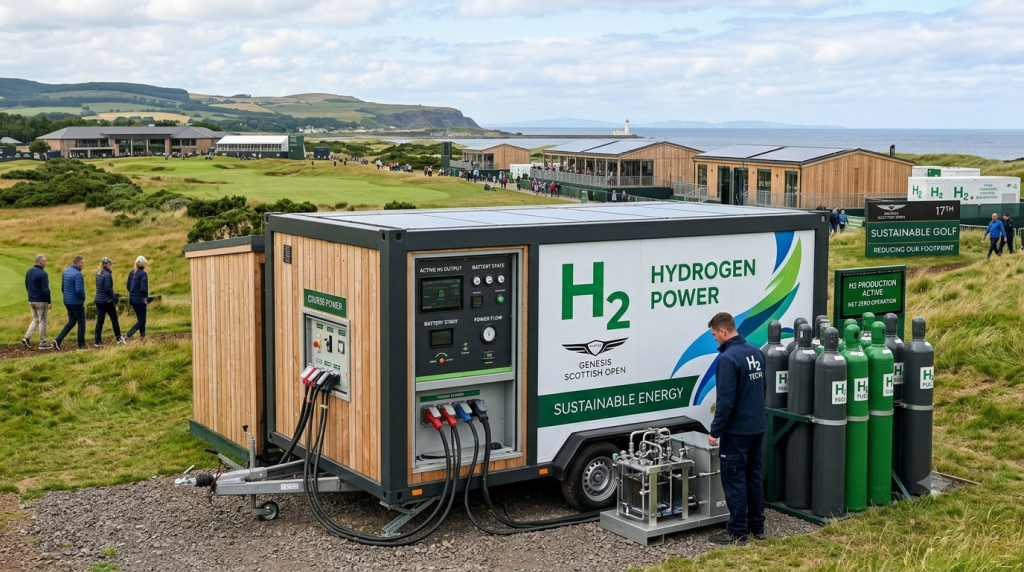
The most striking shift this year was the tournament’s energy strategy. For decades, golf events have relied on diesel generators that hum and belch emissions throughout the tournament. This year, the team swapped those out for a large-scale deployment of green hydrogen and solar power. (Ref:5 & 1)
Seeing hydrogen power units (HPUs) powering everything from the broadcast compound to the hospitality areas and big screens is the kind of “boring” but beautiful engineering that actually makes a difference. By moving away from diesel, they’ve saved over 16,200 kg of CO2e. That is a massive, quantifiable win for our climate – and that is just one weekend tournament. (Ref: 2)
Small Shifts, Big Impact
Beyond the high-tech energy solutions, what really caught my eye were the “quiet” sustainability efforts that show a commitment to genuine change:
- Zero-Waste Ambition: The event has maintained a 100% waste-to-landfill diversion rate, proving that large-scale events don’t have to leave a trail of trash behind. (Ref: 4)
- Locally Sourced Catering: By sourcing food within a 50-mile radius, they are drastically cutting the “food miles” and freight emissions usually associated with feeding thousands of spectators. (Ref: 5)
- Plastic-Free Initiatives: Since 2023, the event has successfully removed all single-use plastics from site-wide catering – a simple yet transformative change that feels like a breath of fresh air. (Ref: 4)
- Community Connection: Sustainability isn’t just about carbon; it’s about habitat. The tournament has focused on connecting fans with the local environment, even organising beach clean-ups and dune-preservation efforts with the professional players themselves. (Ref: 4)

MY SUSTAINABILITY DEFINITION: MEETING TODAY’S NEEDS WITHOUT RUINING TOMORROW. Support the Stories: I truly believe that sharing these stories helps keep us all connected and inspired to do better by our planet. If you enjoy reading my articles and want to help keep this platform running, please consider clicking the “Sponsor My Writing” button in the top right corner. As a little extra thank you, anyone based in the UK who sponsors £10 or more will get a penguin coaster or two sent right to their door! Your support means the world and directly fuels the next article.
Why This Matters
As I’ve often written, I love highlighting the eco-heroes who are doing the work behind the scenes. The Genesis Scottish Open isn’t just a golf tournament anymore; it’s a living case study that could be followed by others, with a little thought and work. It demonstrates that whether you’re running a small local business or a massive international sporting event, the “environmental responsibility disconnect” – that gap between saying we care and actually doing the work – can be closed. As well as delivering a fantastic golf event, they completed it with a big tick for my definition of sustainability – ‘Meeting Today’s Needs Without Ruining Tomorrow’.
It’s easy to feel overwhelmed by the state of our planet, but stories like this remind me that change is possible when people prioritise the earth, not just the bottom line. It’s about incremental gains, one generator swap and one plastic-free cup at a time.
References:
- 1 – DP World Tour. (2026). Genesis Scottish Open sets new sustainability benchmark by embracing hydrogen and solar power. [online] Available at: https://www.europeantour.com/dpworld-tour/rolex/news/articles/detail/genesis-scottish-open-sets-new-sustainability-benchmark-by-embracing-hydrogen-and-solar-power/
- 2 – Golf Sustainable. (2026). Scottish Open sets new standards for the energy transition. [online] Available at: https://golfsustainable.com/en/scottish-open-energy-transition/Golf Sustainable
- 3 – Global Sustainable Sport. (2026). Hydrogen on the Fairways: Genesis Scottish Open Raises the Bar for Sustainable Events. [online] Available at: https://www.globalsustainablesport.com/hydrogen-on-the-fairways-genesis-scottish-open-raises-the-bar-for-sustainable-events/
- 4 – Pitchcare. (2026). Exploring the Next Generation of Sustainable Golf Tournaments. [online] Available at: https://www.pitchcare.com/blogs/news/exploring-the-next-generation-of-sustainable-golf-tournaments/
- 5 – SBS. (2026). Genesis Scottish Open Boosts Sustainability with Hydrogen and Solar Power. [online] Available at: https://sbs.eco/genesis-scottish-open-sustainability-hydrogen-solar
Footnote: “Please note that while the depictions of the hydrogen power units and ‘Genesis Scottish Open’ branding in these images used are AI-generated illustrations, the event’s real-world commitment to sustainability and hydrogen technology is very much a fact.”